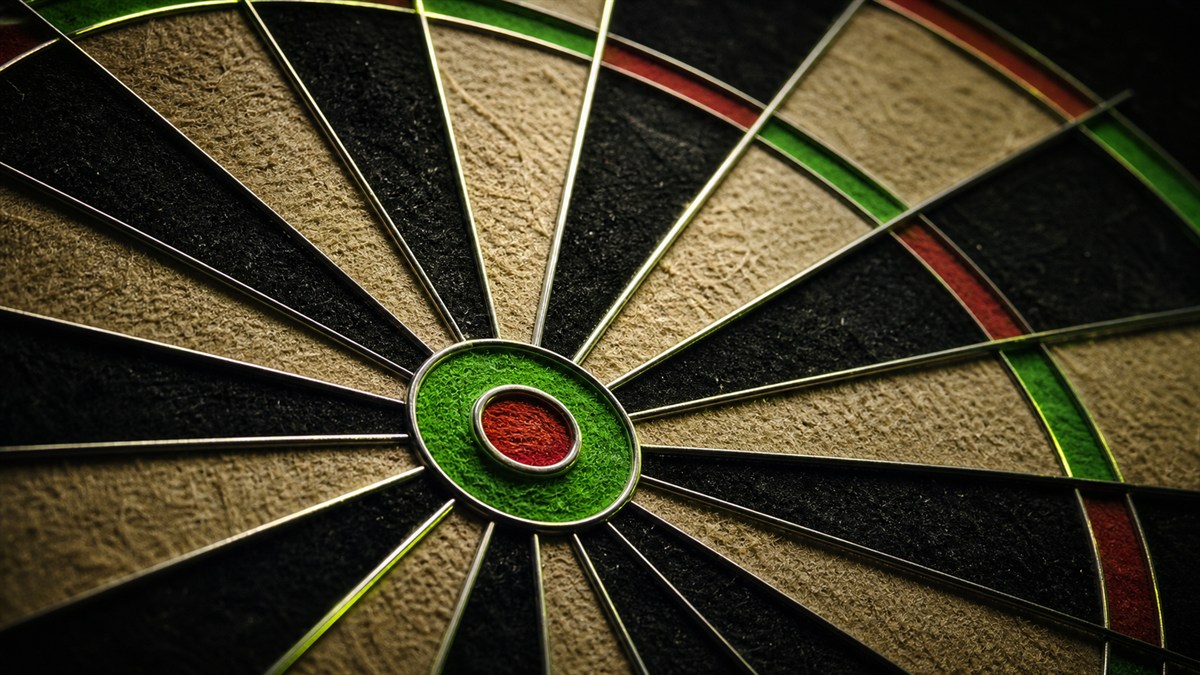
The minimum league standard.
For steel-tip play, begin with a regulation-size bristle board, a staple-free bull, thin embedded wiring and a removable number ring. These features do not guarantee quality, but they remove common causes of bounce-outs and make rotation possible.
A cheap board replaced twice is rarely cheaper than a dependable board maintained properly. For a venue, calculate cost per board-night: purchase price plus surround, mounting, lighting and replacement labour divided by the number of usable league nights. Durability and serviceability usually matter more than decorative packaging.
Sisal, density and wire.
Bristle boards are made from compressed plant fibres designed to close after a point is removed. Look for a surface that is firm and even, with no obvious soft zones, bulges or large colour bleed. Excessively hard boards can reject ordinary points; very soft boards can mark quickly and hold darts inconsistently.
Thin wiring increases playable area, especially around trebles and doubles. Embedded or blade-style dividers generally deflect fewer darts than thick round wire. Inspect the bull assembly as well: staples and bulky rings add obstacles precisely where high-value darts land.
| Feature | Why it matters | Venue test |
|---|---|---|
| Even fibre density | Predictable point retention | Throw ordinary smooth points across several segments |
| Thin embedded wire | More scoring surface, fewer deflections | Inspect treble and double intersections |
| Removable number ring | Enables rotation | Confirm numbers detach without moving the board mount |
| Clean bull assembly | Reduces central bounce-outs | Look for a staple-free, low-profile ring |
Installation decides whether regulation exists.
Mount the bull at the regulation height specified by the rules your league follows, and measure the throw line from the face of the board—not from the wall. Use a proper diagonal measurement as a second check. Floors, wall panels and cabinets can change the real geometry, so verify after the complete setup is installed.
The board should sit flat, resist movement during dart removal and still rotate easily. A backing board or purpose-built surround protects the wall. In shared venues, add a visible oche that cannot drift during the night and leave enough space behind the thrower for safe circulation.
No rocking when a dart is removed.
Measure from the board face to the throw line.
Use a surround sized for the players using the lane.
Keep traffic and seating outside the throwing corridor.
Light the segments, not the player.
Uniform light reduces shadows from darts and makes the wire easy to read from the oche. Ring systems are popular because they distribute light around the board; carefully positioned overhead fixtures can also work. Avoid glare in the player’s eyes and avoid a bright centre surrounded by a dark room, which creates visual fatigue.
Check lighting with three darts grouped at different positions. If one dart throws a dark shadow over the next target, adjust the angle or add coverage. Keep colour temperature consistent across every board used in the same matchday.
Rotation is cheaper than replacement.
Remove darts with a straight, controlled pull. Excessive twisting and highly aggressive points can pull fibres. Rotate the board before the 20 segment becomes visibly worn: move the number ring so another dark segment occupies the top position, then confirm the board remains level.
Never soak a modern bristle board. Keep it away from direct heat, moisture and strong sunlight. Inspect wires, the bull, mounting and lighting before league play. When a board develops hard spots, deep bulges, loose wire or unreliable point retention, retire it from competition even if it still looks acceptable from a distance.
Plan the room as a system.
Multiple boards need more than repeated hardware. Standardize the board model, light, surround, mounting height and oche. Give players a clear place for score sheets and drinks away from the scoring surface. Use board numbers that remain visible when a crowd forms.
Keep one spare board, mounting parts and light components if the league cannot afford to lose a lane mid-season. Document the rotation date on the back or in the league maintenance log. Consistent small maintenance is easier than emergency replacement before match night.
What to buy—and what to skip.
| Priority | Buy for | Avoid |
|---|---|---|
| Board | Even bristle, thin wire, removable ring | Novelty surfaces and fixed number rings |
| Mount | Rigid support with easy rotation | Hardware that lets the board rock |
| Light | Uniform, shadow-controlled coverage | Glare and a single harsh spot |
| Protection | Replaceable surround and clear oche | Improvised throw lines that can move |
For home use, prioritize quiet mounting and wall protection. For a bar, prioritize lane consistency, replaceable components and maintenance time. For league ownership, record which board each fixture uses so wear can be distributed across the venue.