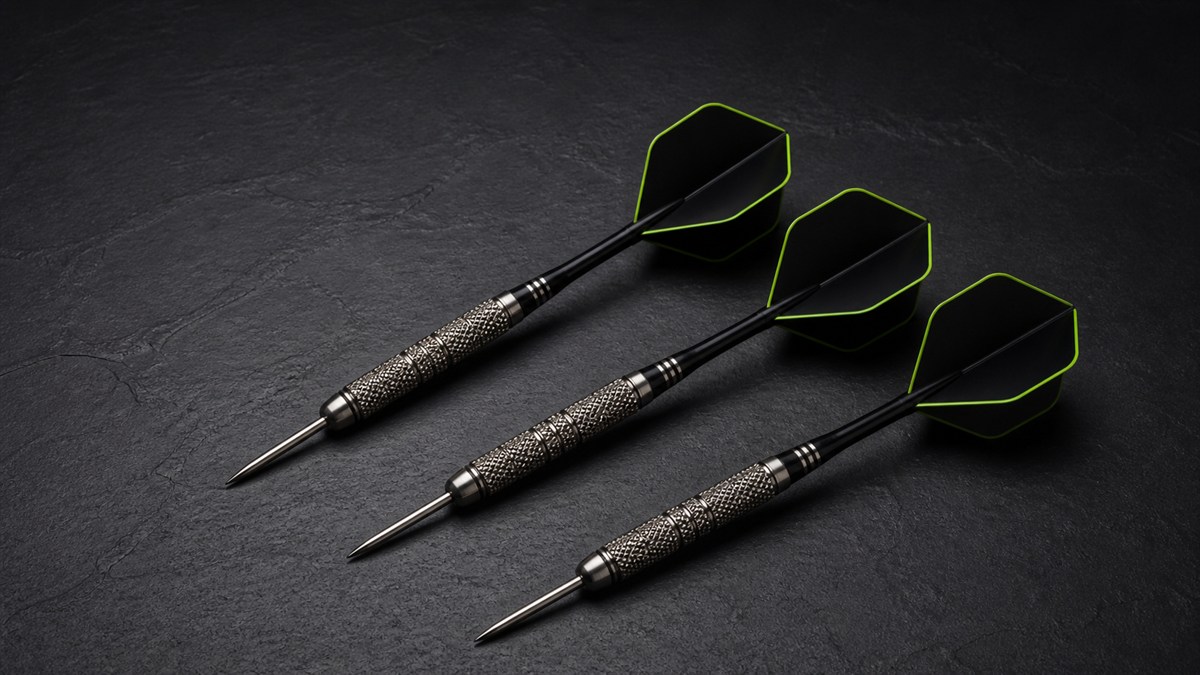
Start neutral. Change one variable.
For a first serious steel-tip set, choose a straight or gently tapered tungsten barrel with a moderate ring grip, a medium shaft and a standard-shape flight. Start near the middle of the weight range available at your local shop. That is not a final answer; it is a controlled baseline that makes differences easier to feel.
Avoid buying by professional-player name alone. A signature dart can be excellent, but it was designed around another person’s fingers, tempo and board entry. Use pro equipment as a geometry reference—front-loaded, centre-balanced, scalloped, smooth—not as proof of fit.
Weight changes timing.
A heavier dart can feel calmer through the stroke and may expose less hand tremor, but it also asks you to release that mass consistently. A lighter dart reacts quickly and may suit a fast, direct throw, yet it can punish small timing changes. Neither is automatically more accurate.
Compare nearby weights rather than extremes. Use identical targets and throw enough visits for the novelty to disappear. Watch three signals: how often the dart slips or hangs in the fingers, whether the board entry is repeatable, and whether your grouping survives late in the session. If a dart works for ten minutes but becomes difficult after an hour, it is not a good league-night fit.
| Feel | Likely advantage | Watch for |
|---|---|---|
| Lighter | Fast acceleration, low effort | Overthrowing and inconsistent release timing |
| Middle weight | Broadest neutral test point | Do not assume neutral means permanent |
| Heavier | Deliberate rhythm and stable feel | Fatigue or pulling the dart through the release |
Tungsten controls width. Shape controls the hand.
Tungsten is dense, so a higher percentage can produce a slimmer barrel at a given weight. Slimmer barrels create more room for tight groups, which matters when the first dart occupies your preferred path. The percentage does not tell you whether the dart will release cleanly, and a well-shaped lower-percentage barrel can outperform a narrow barrel that fights your grip.
Straight barrel
The most adaptable baseline. It gives front, middle and rear grippers room and usually makes replacement easier because the shape is common.
Torpedo or bomb shape
A fuller centre can sit securely in the fingers and concentrate mass. It may suit a compact grip, but the widest point can reduce room in close groups.
Tapered or front-loaded shape
A front bias can encourage a decisive nose-down entry and may suit players who push from the rear. Confirm that the taper does not slide during the draw.
Grip should locate, not punish.
Grip level describes texture, not quality. Deep cuts and sharp knurling feel secure in a showroom, yet they can catch dry skin and delay the release. Smooth barrels can leave the hand beautifully but offer little positional feedback. Most league players benefit from a moderate pattern with one clear reference zone.
Match the pattern to where you actually hold the barrel. Rear grippers need usable machining near the shaft; front grippers need enough point-side space without crowding the point transition. Scallops and distinctive rings can create a reliable landmark, but only if the landmark matches your natural finger placement.
Prioritize front machining and check finger clearance at the point.
A straight barrel or shallow scallop gives a repeatable midpoint.
Confirm the grip continues far enough back and the shaft join feels clean.
Use a long, consistent pattern while you learn where your hand settles.
The barrel is only half the flight.
A longer shaft generally moves the flight farther behind the barrel and can increase leverage; a shorter shaft compacts the setup. Larger flights provide more drag and often stabilize a slower dart, while smaller flights reduce drag for flatter, faster trajectories. Change one part at a time and keep the barrel constant.
Points influence board grip and finger placement. Aggressive board-gripping textures may protect against bounce-outs but can wear sisal when twisted out carelessly. If your finger rests on the point, a gentle finger-grip section may help. For league venues, favor points that hold reliably without damaging boards.
A useful 30-minute shop test.
- Warm up with your current darts for five minutes so the first comparison is not simply warm muscles versus cold muscles.
- Choose two candidates that differ in one main variable: weight, shape or grip.
- Throw ten visits at the 20, ten at a large single and ten at a checkout target. A league dart must support scoring and finishing.
- Record release misses, not just scores. Note snags, slips and darts that land at a dramatically different angle.
- Repeat the better candidate after a short break. A winner should remain comfortable when the excitement of a new set fades.
Do not overvalue one 180 or one terrible visit. Look for a smaller dispersion pattern, fewer bad releases and a setup that requires less conscious correction.
Spend where geometry improves.
| Level | What to prioritize | What can wait |
|---|---|---|
| First league set | Comfortable barrel, replaceable shafts and flights, protective case | Complex coatings and collectible packaging |
| Established player | Exact geometry, consistent machining, spare matching set | Frequent cosmetic changes |
| Travel or tournament | Second identical set, spare points and complete consumables | Unproven last-minute changes |
Before buying, write down the weight, barrel dimensions, balance, grip position and shaft/flight combination you want. Then use current listings to compare like with like instead of sorting only by discount.